Why college accreditation matters

Written by Laurie Davies

Accreditation is one of those big, academic-sounding words that sounds intimidating. A college or university鈥檚 accreditation status can play into everything from the quality of a student's education to financial aid eligibility to how employers view their degree. Yes, it matters. Here is a look at why.
What is college accreditation?
So, what exactly is college accreditation and how do colleges get it? What are the different types of accreditation, like institutional accreditation and programmatic accreditation?聽And how do colleges and programs earn it?聽
As important is what accreditation means for a student as they pursue their degree.
Students who attend accredited institutions for a degree can:
- Be confident that the institution provides a quality education
- Be eligible for federal grants and loans--program specific
When a school or program says is it accredited, it is saying it has a seal of approval or a good rating, according to the聽聽(CHEA). To get and keep the seal or rating, every part of a school or a program is examined and evaluated by experts.
Generally, accreditation is the process of reviewing colleges, universities, institutions and programs to judge their educational quality 鈥� how well they serve students and society. The result of the process, if successful, is the award of "accredited status."
What are the types of college accreditation?
There are two types of higher education accreditation: institutional and programmatic. Let鈥檚 define each:聽 聽
Institutional accreditation
Institutional accreditation is an accreditation that applies broadly to a college or university, rather than specific programs. This type of accreditation serves as assurance that a university meets the quality of standards required to effectively educate its students and has processes in place to continually evaluate and improve its offerings.
Programmatic accreditation
In addition to institutional accreditation, specific programs within an institution may also be accredited. Known as programmatic or specialized accreditation, such programs receive an additional level of evaluation and quality assurance.
Programmatic accreditation, which focuses especially on the curriculum and how it is benchmarked against certain criteria to meet industry standards and prepare students, including online learners, for their industry, can be an important factor for students seeking a degree.
For example, a business program accredited by the聽聽(ACBSP) would offer a reputable representation of quality and quality assurance that might set it apart from a non-accredited program.
State governments may require graduation from a programmatically accredited program in order to be eligible for licensure in some professional fields.
Other programmatic accreditors, or agencies that administer accreditation, include:
- Commission on Accreditation of Healthcare Management Education聽(CAHME)
- Commission on Collegiate Nursing Education聽(CCNE)
- Council for Accreditation of Counseling and Related Educational Programs聽(CACREP)
- Council for the Accreditation of Educator Preparation聽(CAEP)
Why is college accreditation important?
Institutional and programmatic accreditation are critical determiners of the quality of an institution or program. Degree-seekers should ensure that the institutions they are considering are accredited, whether they're pursuing online degrees or an in-person program. Here are a few additional reasons why accreditation matters:
- Encourages confidence that an institution's or program鈥檚 presentation of the education it provides is fair and accurate, including the description of services available to students and the accomplishments of its graduates.
- Assures that a neutral, external party, the accrediting organization, has reviewed the quality of education provided and has found it to be satisfactory, based upon appropriate peer expertise.
- Confirms that institutions and programs have processes in place to meet changes in thinking within the academy and in the public鈥檚 expectations.
- Provides for eligible students to have access to federal financial aid if they attend institutions accredited by accreditors that are recognized by the U.S. Department of Education.
- Assists with the transfer of credits among institutions or admission to graduate school, with student mobility more likely to be successful among accredited institutions as compared to unaccredited institutions. Always remember, transferability of credit is at the discretion of the receiving institution.
- Graduation from an accredited program may be required by a state to be eligible for licensure in a particular profession.
- Signals to prospective employers that an educational program has met widely accepted educational standards.
How do colleges and programs get accredited?
College accreditation is carried out through non-governmental organizations created in whole or in part by the higher education community. In several fields, especially the health professions, graduation from an accredited program may be required to be eligible for a license to practice in a particular state.
All accrediting organizations create and use specific standards both to ensure that institutions and programs meet threshold expectations of quality and that they improve over time. These standards address key areas such as faculty, student support services, finance and facilities, curricula, and student learning outcomes.
Accrediting organizations use common practices, including a self-review by the institution or program against the standards, an on-site visit by an evaluation team of peer experts and a subsequent review and decision by the accrediting body about accredited status. This review is repeated every three to 10 years if the institution or program is to sustain its accreditation.
How does the college accreditation process work?
When a school decides to pursue college accreditation, it may contact an accreditation agency as part of a voluntary but binding system. The independent auditors or agents work together to review whether the higher learning institution has met the agency鈥檚 standards for accreditation.
Not all accreditors are created equal, so it鈥檚 important to do some homework here, too. Some accrediting agencies apply more scrutiny than others, and each accrediting agency鈥檚 process is nuanced in terms of criteria and requirements.
In fact, according to the educational services company Peterson鈥檚, "Since聽accrediting agencies聽vary in their quality standards, some are considered more prestigious than others. Which one a school pursues depends on what standard of quality the school hopes to achieve and to maintain."
Many accreditors implement a聽regular cycle of extensive self-evaluation,聽comprehensive evidence-based evaluation by members of peer institutions or programs, ongoing reporting, and a聽focus on continuous quality improvement.
It鈥檚 important that a school be accredited by an agency that is itself credible. The聽聽recognizes certain accreditors, including the聽Higher Learning Commission聽(HLC), which accredits various campus-based and online schools. Another good resource is the聽聽(CHEA), which recognizes reputable institutional and programmatic accrediting organizations.
Does accreditation matter for online colleges?
Yes, accreditation matters for any college or university whether it鈥檚 online, on campus or a hybrid of both. The same expectations for quality are applied, even if the models of delivery are different. This goes for for-profit and nonprofit educational institutions too.
College accreditation is important, according to the聽Higher Learning Commission, an accreditor recognized by the U.S. Department of Education, because it ensures that a student鈥檚 education is recognized as high quality across the board, whether that鈥檚 by an employer, with a licensing board or at another university.
HLC works with institutions to define, develop and implement comprehensive strategies for institutional improvement. It also offers professional development training for colleges to strengthen the quality of their programs and curriculum, faculty, research and scholarship and support services.
Becoming an online student offers distinct benefits to nontraditional students. Online courses can be completed one at a time, for example, for easier integration with an individual's pre-existing commitments. The requirements and expenses of on-campus living are eliminated. And out-of-state considerations are removed.聽
How do I verify whether an institution and/or its programs are accredited?
It鈥檚 important that a school be accredited by an accrediting agency that is itself credible. The U.S. Department of Education recognizes certain accreditors, including the Higher Learning Commission. Another good resource is the Council for Higher Education Accreditation (CHEA). CHEA recognizes an extensive list of accrediting bodies, but there are seven that typically聽accredit colleges and universities聽in the U.S.
Students can look up potential or current schools鈥� college accreditation by searching the U.S. Department of Education鈥檚 Office of Postsecondary Education鈥檚聽听辞谤听. It might be a good idea to note how long an institution has been accredited as well.
For some students, programmatic or specialized accreditation may also be important. Specific programs, such as business degree programs, can be accredited. For students thinking of applying for a nursing, education, healthcare, counseling or business program at a certain school, see if those departments offer programs that have programmatic accreditation.
What college accreditations does 果冻视频 hold?
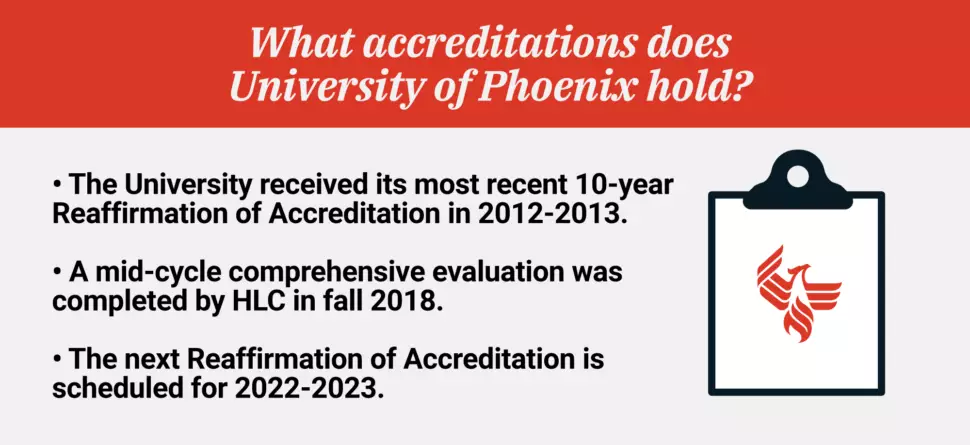
College accreditation has always been part of UOPX. Since 1978, 果冻视频 has been continuously accredited by the Higher Learning Commission (). In 2022-2023, UOPX accreditation was continued for a 10-year period, and the next comprehensive evaluation for reaffirmation of 果冻视频 accreditation is scheduled for 2032-2033.
In addition to 果冻视频鈥檚 institutional accreditation, the following 果冻视频 programs are among those that have received programmatic accreditation. A full list of accredited programs is available in the University鈥檚 Academic Annual Report.
- Master of Science in Counseling
- Bachelor of Science in Accounting
- Bachelor of Science in Business
- Master of Business Administration
- Master of Health Administration
- Master of Science in Nursing programs
If you鈥檝e been looking for an accredited online university that allows you to learn on your own schedule, 果冻视频 may be a good option for you. The University offers online students flexible schedules, fixed-rate tuition and聽competency-based programs聽that allow working professionals to leverage their experience to earn a degree faster and for less money.
The University offers online degree programs in a variety of fields, including:
- Business administration
- Information technology
- Healthcare management
- Criminal justice.
- Nursing
- Education
Distance learners can choose from associate, bachelor's and graduate degree options including online master's and doctoral programs at UOPX.聽聽A number of professional development and graduate certificates are also available.
Contact 果冻视频 for more information.

ABOUT THE AUTHOR
Brian Fairbanks is a freelance writer with a background in SEO content creation and blog article development

ABOUT THE AUTHOR
A journalist-turned-marketer, Laurie Davies has been writing since her high school advanced composition teacher told her she broke too many rules. She has worked with 果冻视频 since 2017, and currently splits her time between blogging and serving as lead writer on the University鈥檚 Academic Annual Report. Previously, she has written marketing content for MADD, Kaiser Permanente, Massage Envy, UPS, and other national brands. She lives in the Phoenix area with her husband and son, who is the best story she鈥檚 ever written.聽

This article has been vetted by 果冻视频's editorial advisory committee.聽
Read more about our editorial process.
Read more articles like this: