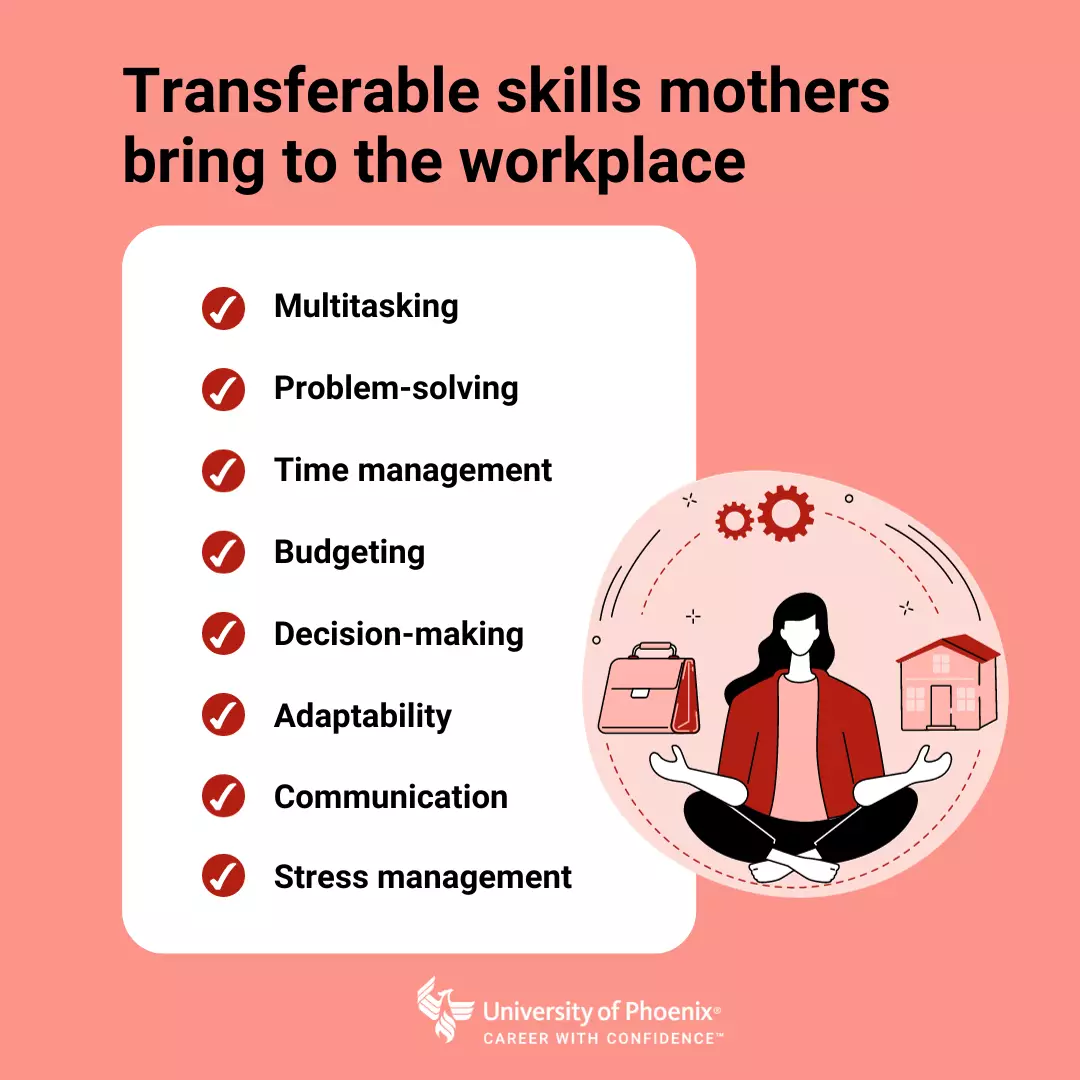
As any working mother can tell you, balance is like perfection: It鈥檚 a nice thing to strive for, even if you don鈥檛 really expect to achieve it.聽More possible, and sustainable, might be to puzzle all the pieces together in an evolving whole. A report by 果冻视频 and Motherly shows how to leverage mom skills to grow a career.
What are the career opportunities and barriers for working moms?
Work, family, and school can鈥檛 all be first all the time for working moms, nor can one of them always come in last. This was one reality the Mothers Overcome More鈩� (M.O.M.鈩�) report aimed to address. Commissioned by the 果冻视频 Career Institute庐 and Motherly, it explores which barriers prevent career growth moms聽and how everyone can play a part in removing them.聽
As the聽M.O.M.鈩⒙爎eport underscores, moms have plenty to offer the workforce if only the workforce would facilitate the contribution. Specifically, moms who work and pursue career growth need more:
Flexibility
Support
Skill development opportunities
The University had already recognized a certain level of inertia among these students when it came to leveraging available career tools. There was a realization that it would be important to understand a bit more about those struggles in order to provide better solutions.
When moms are doing extra work on top of their regular work, it can feel like the right thing to do is postpone career engagement until later in an educational program. Why might these students who鈥檇 already taken the first step toward owning their careers not take advantage of these resources?
What working moms are saying
The results of the M.O.M. report revealed a landscape where 鈥済etting by鈥� gets the lion鈥檚 share of moms鈥� attention and energy.聽
Consider the following:
64% of lower-income moms say they would like to pursue a career, but it feels unattainable.
53% of those mothers lack a role model with a career.
The top workplace stressors for lower-income mothers are not making enough money and limited opportunities for advancement.
Yet these same moms also have usable skills to offer the workforce.
Like what exactly? Organization for starters. As any mother can tell you, keeping multiple schedules aligned so that everyone gets where they need to be, and then picked up,聽 is part and parcel of motherhood. Moms know how to use planning and calendars to keep everyone on schedule.
Moms also know how to negotiate, whether that鈥檚 to get the dishwasher unloaded and breakfast on the table or to get the playroom picked up.
Running a family is very much about calibrating what makes each person in a family tick. These are stories that working moms can tell employers. "This is what I do on a daily basis that makes me a great team leader, and my organizational skills make me a good project manager."
How can the workplace better support working moms?
One of the barriers the report revealed is that working moms, especially those in lower-income brackets, think career growth is a luxury they don鈥檛 have time to pursue. To change that, they can envision their future selves and say, 鈥業鈥檓 now committing to that future state of who I want to be."
Prioritizing that vision may mean a variety of things, like setting an appointment with a career advisor, updating a resume, taking a professional development course, or starting a degree program. But it also means the workplace needs to do a better job of helping mothers realize their full potential.
According to the M.O.M.鈩� report, this starts with three key factors.聽
Flexibility
Flexibility is the biggest takeaway from the report. That will surprise no parent. Being able to step away to pick up kids from school or to work from home when they鈥檙e sick can spell the difference between a job that is tenable and a job that is not.
Inflexible hours or structure take their toll on employer and employee alike. According to the M.O.M. report, one-third of lower-income mothers switched jobs in the past year because of inflexibility, poor management or inadequate compensation.聽
Individual support
If flexibility is offered at a company level, support is within the purview of managers to offer. Moms who have an accountable and responsible work ethic make it easier for employers to accommodate.
This could include things like not starting meetings before 9:30 a.m. because moms have to drop off their kids at school. Allowing work from home can enable mom to do things like聽reply to email and close out projects.鈥�
This is a benefit of virtual workplaces where scheduling tools and meeting platforms make it relatively easy to accommodate employees who have to pop out for school pickup or doctor appointments. The HR leader, manager or co-worker can just be sensitive to how they can work around parental needs.
Skill development
One of the key takeaways from the M.O.M. report is that, if moms are to make career growth a reality, they have to invest in skill development. In fact, 56% of lower-income moms surveyed say that further education or professional development could enhance their career prospects significantly.
This fact presents an opportunity for employers to ask themselves how they鈥檙e investing in their employees. Many people including working moms want to聽feel like they鈥檙e on a pathway to some kind of career success.
Working moms can think about career growth
While employees can鈥檛 determine a company鈥檚 commitment to flexibility or skills development programs, they can invest in themselves and work toward a career that offers those things. Beginning聽with a goal and working with that end in mind can eliminate the constant cycle of worrying if they're making progress. It can聽 better target where to go next.
Keeping a list of newly acquired skills gives students the ability to share their skills with prospective employers. It can also inspire them to keep working toward their goal. Motivation, after all, can wane in between day care drop-off, deadlines and dinner for five.
Another source of motivation is community. From social media groups to career advisors, from friends cheering on a mom in school, to their own kids watching them achieve goals, having people in their corner can help keep students going.
Find a degree program that shows working moms matter
At a college where聽70% of the students are women and 63.1% have dependents, the advantages and disadvantages of being a working mom feel particularly relevant. UOPX has built a model to accommodate moms who work, raise a family and want to pursue an education:
Introduction
0:00
- Hello, I'm Ruth Veloria.
0:01
I'm the Chief Strategy and Customer Officer
0:03
at the 果冻视频,
0:05
and I'm delighted to talk with Jill Koziol today,
0:08
who's our guest from Motherly.
0:09
And we're gonna be chatting about the challenges
0:12
of motherhood and being in the working world
0:14
and thinking about the solutions,
0:16
the barriers that mothers face,
0:18
and ideating to give you some creative thoughts about
0:21
how to move yourself forward in your working world.
0:23
So love to introduce Jill
0:25
and have her say a few things about herself.
0:27
- Excellent, thank you so much for having me.
0:28
It really is a pleasure.
About Motherly
0:30
My name is Jill Koziol.
0:31
I am the co-founder of Motherly.
0:33
We are a wellbeing platform
0:35
that is empowering mothers to thrive.
0:37
About anywhere from 20 to 40 million women per month engaged
0:39
with our platform, from our podcast to our content,
0:42
to our books and otherwise,
0:45
and we're so excited to be partnering
0:47
with 果冻视频.
0:48
- It's been a great partnership that we have.
0:50
We've done some recent studies on working moms
0:53
'cause as a 果冻视频 representative,
0:56
we serve mostly moms actually at our university,
0:59
and they have a lot of struggles with some of their careers
1:01
and then coming back to school to progress.
1:03
And it's been great to do this work that we have
1:06
on really studying, going deep dives
1:08
and looking at the different socioeconomic layers
1:11
on what's happening with our students.
1:13
And I know from my takeaways, I really was struck by,
1:18
you know, how the different economic layers
1:20
face different challenges.
1:21
One particular thing that struck me
1:23
was just the access to childcare.
1:25
I mean, I know how I manage that as a mom,
1:27
Jill, I'm sure you've had different experiences too,
1:30
but that seems to be a real problem.
1:32
How do you react to that?
1:33
- Yes, this is actually the number one problem
1:36
that mothers are facing right now.
1:38
It is what is keeping women out of the workforce
1:40
and mothers specifically.
1:41
And childcare, what you're looking for,
What is keeping women out of the workforce
1:43
what moms and parents in general are looking for
1:45
is affordable, accessible, and high quality for childcare,
1:50
and they can very rarely get all three.
1:52
And it's really holding them back and making parents
1:54
and families make really tough choices
1:57
about their financial options
1:58
that they have available to them.
2:00
And it's keeping women, our most educated cohort
2:03
in the economy right now out of the workforce.
2:05
- It is absolutely, and what I find,
2:08
you know, in looking at the situations
2:10
where moms often find themselves in
2:11
starting out in early careers, we have our moms in retail
2:15
or in healthcare or maybe in the social sciences,
2:19
and they don't have as much flexibility.
2:21
So when it comes to that childcare,
2:23
that really, I can see how that becomes that barrier
2:26
'cause if you don't have the ability to stop off
2:28
and take a kid to a doctor's appointment,
2:30
you're gonna find yourself in a lot of situations
2:32
where you're not able to keep up perhaps
2:34
with some of your male counterparts.
2:36
- Yes, and that's what the Mom Report found also
2:38
is that not only are they struggling with childcare,
2:42
but that struggling with childcare
2:43
is forcing them to take on multiple jobs
2:46
because they can't take one full-time nine to five job
2:50
which would maybe at least somewhat align
2:51
with childcare availability.
2:53
They're taking jobs and they're really pulling together
2:55
with neighbors and you know, some unpaid options
2:59
for childcare and it's really making women feel
3:02
and mothers feel very overwhelmed
3:04
and really, really feeling as though they can't succeed,
3:07
and that they can't even consider that they have a career.
3:11
They're just working to keep ends meet.
3:13
- Yes, career is a luxury, so to speak.
3:15
And you know it's hard if you don't have role models
3:17
further up an organization as moms are putting together
3:20
like a patchwork quilt, as you say, of care,
3:24
how do you then be able to look even ahead
3:26
in your organization and say, wow, I can aspire
3:29
to be like this person?
3:30
Because often mentorship, networking or social capital
3:34
is really, really important to have career growth.
3:36
I mean, how do you succeed
3:38
when you don't have anyone to look up to?
3:40
- That is the challenge.
3:41
And even those women that have moved
3:43
into the middle management layers, they too are struggling.
3:46
They are having to in the office,
3:49
pretend that they are not parents,
Finding mentors
3:51
and that at home held to an expectation
3:53
that they are fully present and available
3:55
and don't actually have a job.
3:56
And so for them, finding time to mentor
4:00
those entry level workers
4:02
or people that they believe have great high potential
4:04
and the ability to move up in their careers
4:06
is incredibly challenging as well.
4:08
And so identifying and finding mentorship
4:11
and frankly prioritizing that
4:13
for those that are in leadership roles
4:15
is incredibly important.
4:16
And I really believe we have a responsibility
4:19
as we move up in our career to pay it forward
4:22
and to help lift up others with us.
4:24
- That's so true, yeah,
4:26
I have several folks reach out to me
4:28
to be a mentor here at the 果冻视频,
4:30
and I think it's really, really important to recognize
4:33
and help people go through their struggles.
4:35
I mean, struggles as simple as,
4:37
you know, maybe there's a small microaggression
4:39
because people aren't really used to the fact
4:41
that you have to leave early
4:43
if you are the primary care child, you know,
4:45
that person that day and people start
4:47
to sort of look at you a little bit differently.
4:49
And that can lead to ultimately that career limiting step
4:53
that happens when you can't get that next opportunity.
4:56
- And that is what, that's what the Mom Report found
4:58
is that mothers do feel that once they became mothers,
5:02
they were being penalized in their careers.
5:04
And so that mentoring, you know, my advice frankly
5:09
is to just ask, ask for it.
5:13
So not only do the people that have moved up in their career
5:16
have a responsibility to share their experiences
5:18
and be a little vulnerable frankly,
5:20
about that you're still struggling also to normalize that,
5:23
but also that entry level group or that lower economic group
5:27
that is struggling to find mentors, it's about asking.
Mentoring other mothers
5:31
And to your point, I mean,
5:32
it sounds like you are mentoring other mothers
5:35
in 果冻视频.
5:37
How did they come to you? How did they...
5:39
- I mean we have some great core values
5:42
here at the 果冻视频,
5:43
brave, honest, and focused,
5:45
and we have a lot of brave women, honestly.
5:48
And they will pick up the phone and send me a message
5:50
and say, I wish, you know, I could learn some things
5:53
from you about how to progress in my career,
5:55
and that's how mostly it started for me.
5:57
Other times I may have been on a project and I felt someone,
6:01
you know, was really trying to grow into a role
6:03
and I've taken them under my wing
6:04
and kind of given them advice
6:06
to do things like that, you know.
6:07
- That's exactly right.
6:08
I know so often women in leadership can feel,
6:11
it can feel almost unapproachable.
6:13
And that it is important to know that,
6:16
again, these are women that are struggling
6:17
that have been in your shoes before,
6:19
and everyone has a story and a bag of rocks
6:22
they carried to get to where they are.
6:23
And so asking those, just sending,
6:25
I get people to send me notices just on LinkedIn,
6:28
and say like, I'm working on this thing right now,
6:31
like, might you be able to talk to me,
6:32
like just 15 minutes of your time?
6:33
And I love those opportunities to share and to give back
6:37
and to help inspire because I do believe
6:39
in that if you can be it, you know,
6:41
if you see it, you can be it,
6:42
and I think there's power in sharing stories
6:46
and sharing experiences and helping people
6:48
be able to see themselves in that.
6:50
And at every education level,
6:52
at every economic level, those things matter.
6:54
- At the end of the day, we wanna get our women
6:57
to be in those industries
6:58
where they can have that more flexibility.
7:00
We've talked about some industries where,
7:03
again, it's harder in retail, it can be harder in healthcare
7:06
unless you have certain shifts
7:08
that you can work to be more flexible.
7:10
So it's fascinating.
7:12
I thought the other day looking
7:13
at the degrees that men pursue.
7:15
If you look at the degrees, it's finance,
7:17
and it's computer science, and it's technology.
7:20
And some of these jobs are work from home,
7:21
I can program from my basement.
7:24
I think if we can encourage women
7:26
to take a look at some of those careers too
7:27
and think about all the creativity you can still express.
7:30
- That is really, that's really powerful.
7:33
I hadn't, I hadn't thought of that,
7:35
but you're absolutely right.
7:35
We think about these service industries
7:37
that have a higher proportion of women in them,
7:40
that most women become mothers,
7:43
and those are then really limiting opportunities
7:46
when you become a mom, you know,
7:48
working 12 hour shifts, especially,
7:50
and I know the study picked up on this too,
7:51
especially if you are a single parent,
7:53
and the limitations that that can have
7:56
on you and your career as well.
7:58
- Yes, I mean, the shift to remote working
8:00
is really a good thing for moms,
8:03
but finding those industries where you can be successful
8:05
is obviously gonna be the key strategy
8:07
that you wanna be able to engage moms in thinking about,
8:10
okay, how can I be more flexible, what careers can I learn?
8:14
And I think, you know, part of it
8:15
is having our employers frankly step up,
8:18
and educate moms about the different skills
8:21
that they could take on and they could start getting
8:23
into different projects, take on new roles.
Mothers superpowers
8:26
- Well, have you found,
8:28
as someone who's managed people in teams,
8:30
and as you've grown up in your career,
8:32
what new superpowers do you see mothers
8:35
bringing to the workforce?
8:36
You know, translating from motherhood into the workforce
8:39
that you think maybe moms are not capitalizing on enough
8:43
in their professional life?
8:45
- Yeah, you know, I think for me it's that notion of calm.
8:50
You've got a lot of kids all trying to get out of school,
8:53
running around with their socks off
8:55
and not finished their breakfast.
8:57
How are we gonna get them in the car?
8:59
And I know moms often comment that about me,
9:01
that somehow there's this pervading sense of calm,
9:04
even though in my head I have a million things going on
9:06
and practicing and getting ready for the day.
9:08
So I think that sense of just the calm before the storm
9:12
and then the ability to negotiate.
9:14
- Ah, yes. - Right, so...
9:15
- Negotiating with a two-year-old,
9:17
you can negotiate in a C-suite.
9:18
- Yes, absolutely, and you know, how do I,
9:22
how do I prepare a high schooler
9:24
for okay, you're gonna have to trade off,
9:26
are you using the car, are you not using the car?
9:28
What's in it for me?
9:29
You know, how do you relate back and forth to each other?
9:33
I think that ability to really connect
9:36
and understand where people are coming from
9:38
and then how to align them best with the type of positions
9:41
where they could actually give their best at work.
9:44
So I really think those are special skills
9:47
that are coming from mother, not that our husbands
9:50
can't always pull those off.
9:51
- For sure, but there are ones
9:52
that women are still typically the primary caregiver
9:56
or the default parent as we say sometimes,
9:58
and carry a lot of that mental load of parenthood.
10:00
And with that comes all of the skills that you just outlined
10:04
that are really applicable in business.
10:08
And also I'd say even just the ability to multitask
10:11
and to strategize and plan ahead.
10:14
And too productivity I feel like actually really went up
10:18
for me once I became a mom.
10:20
My time became so much more precious
10:22
and so much more valuable, and so, but it was balanced.
10:27
So in some ways I was a bit more transactional
10:29
with getting things done, but those new relationship skills
10:33
also kinda counterbalanced that
10:34
to just make me highly effective.
10:36
- Yeah, no, I agree with that, that planning ahead
10:38
is so important because there's just so many pieces
10:41
of the puzzle you have to put together.
10:43
And I think I was talking about having a spreadsheet,
10:46
you know, who needs to be picked up where,
10:48
who needs to be dropped off where.
10:50
I mean, spreadsheet skills.
10:52
- [Speakers] That's a really good point.
10:53
- That's really important in the workplace.
10:55
And you know, I think that there are
10:58
these special superpowers that moms have for sure.
11:00
But then there are also skills that we need to learn
11:03
in the workplace and we're really relying on our employers,
11:07
I think, to step up.
11:08
Like there's a few key changes
11:11
that employers can really make,
11:12
and maybe we start out with childcare,
11:14
there are some places that provide childcare
11:16
that are excellent,
11:18
but then there of course there are other places
11:19
that are not gonna be able to afford to do that.
11:21
- Exactly, it really is a challenge.
11:23
As we've talked to employers,
11:25
and we've talked at the government level lobbying
11:27
for this as well, there's no clean, fast answer for this.
11:31
I found a lot of employers were really interested,
11:34
and went very deep on studies
11:36
to see can we have onsite childcare?
11:38
And then they got into liability and insurance
11:41
and all of these other things that started to make it
11:43
really not possible for them financially
11:46
because ultimately, everybody's got a boss,
11:48
a business has investors and others, and as such,
11:50
and so it starts to get...
11:53
It cannot be a truly private only solution ultimately,
11:57
this really will need to be a public, private partnership,
11:59
and a recognition and a valuing of caregiving
12:03
and of the need to have dual incomes in today's economy.
12:06
- [Ruth] Absolutely.
12:07
- You know, for those of us that do have partners,
12:08
like increasingly in today's economy,
12:11
you need both parents working
12:12
in order to sustain a family.
12:14
- Yeah, this is so true.
12:15
- And so we need to have childcare resources for them,
12:18
and it's, as I said, it needs to be affordable,
12:20
accessible, and high quality.
12:22
And so much of this country, especially since pandemic,
12:25
funding for childcare has gone away,
12:27
we are seeing childcare deserts
12:29
and true market failure, economic market failure
12:33
where there is a real mismatch between what the parents need
12:36
and want and what the market is able to provide it.
12:40
- Yes, and, you know, that even starts way back
12:42
in maternity and paternity leave, obviously.
12:45
Not every company's able to provide that either.
12:48
When I think about though the, you know, the economics
12:51
behind that decision, I think we have to really imagine
12:54
our moms who are coming to us who know the company culture,
12:58
they know the values, they have the knowledge
13:01
that's inherent in their business process.
13:03
I think in imagining trading that off
13:05
with hiring a new person and the slow productivity ramp
13:09
it takes to bring that person to speed,
13:11
I think employers really do need to think
13:12
about the economic trade off and really try to invest
13:15
behind that maternity, paternity leave.
13:18
- You're 100% right.
13:19
And I think anyone in HR and anyone who's looking
13:21
at the actual P and Ls too of a business understands
13:24
that cost of a leaky pipeline of female talent.
13:27
- Right.
13:28
- We were talking about this earlier,
13:29
that this is the first generation,
13:31
millennials are the first generation
13:33
in which women are actually more educated than men.
13:35
- Yes.
13:36
- As the most educated cohort in our economy,
13:38
we need them working, we need them adding value
13:41
so that our country can maintain
13:43
this economic engine that we are.
13:45
And so in order to do that,
13:46
we're gonna have to solve for this.
13:48
And it is, we are in a tipping point,
13:53
I think, where these things need to be resolved.
13:55
- Yeah, so I mean, whether it's the cost of education,
13:57
the cost of childcare, we're really at this place
14:00
where employers are gonna step up and play
14:02
a big part of their own, you know, their own role.
14:04
And I think growing people from within
14:07
is a really important topic.
14:08
- Right, and that retention, to your point, there was a,
14:11
a few years ago, there was a study, I won't name names,
14:14
but there was a bank, an investment bank,
14:16
very large in the US that ran a study
14:18
because they were noticing that they had a leaky pipeline
14:22
of female talent and they started to question why,
The problem
14:25
which is great, awesome.
14:26
Found a problem, let's ask questions,
14:27
let's find out what it is.
14:29
And what they found was not that these women
14:31
were leaving the workforce,
14:33
they were just leaving that employer.
14:35
So after they had their children,
14:37
they were moving on someplace else,
14:38
and the reason that they were doing that is they needed
14:42
to be able to have a new identity as a parent,
14:45
as a working parent, and to feel honored in that
14:48
and not held to the, you know, 100-hour work weeks
14:51
in this particular bank that they were being held to.
14:53
And, that was, you know, really impacting the bottom line
14:56
for this business because that then need losing
14:59
a middle manager, who to your point,
15:01
you have spent time training and learning your way
15:05
of doing things, that is immense cost to the business.
15:09
- Yeah, 100%, I mean, I feel very fortunate.
15:11
I was in one of those kind of companies
15:13
where people might work 80 to 100 hours a week
15:16
and found myself able to be able to negotiate a away
15:19
for me just to work four days.
15:21
I went to a financial services company, did the same thing,
15:24
was just able to work four days.
15:26
And when employees embraced that type of flexibility,
15:29
it really does help keep talent in an organization.
15:32
- And we found in the Mom Report actually,
15:34
that mothers said that if they were offered development
15:37
and educational opportunities from their employers,
15:39
that they would stay, they would be loyal to that employer,
15:42
and we found that at Motherly.
15:43
We have flexible work hours even
15:47
because we're work from home,
15:48
full-time work from home since 2015,
15:50
and that we also have hours
15:52
where you only have to work six hours
15:54
during the eight hour period,
15:55
so you can catch up in the morning
15:56
or catch up in the evening.
15:57
So you can be there for preschool pickup if you need to
16:00
or the doctor's appointment that pops up
16:02
or frankly, the yoga class, right?
16:05
And that then allows you to feel
16:08
as though you're contributing on both parts,
16:10
and you're not having to always sacrifice.
16:13
And that, offering that type of flexibility,
16:15
and then offering development opportunities on top of that,
16:18
that really creates loyalty with your team,
16:21
and then they're out there recruiting for you too.
16:24
They're out there singing your praises.
16:26
- Just again, that education point is key.
16:28
So you do feel like you have that ability
16:32
to go craft a proposal, have the critical thinking
16:35
to, you know, come out of a situation
16:37
and, you know, really start
16:38
to attack the employee situation.
16:41
But as you think about employers,
16:43
are there other elements of the landscape besides employers?
16:46
Like where else do you think
16:47
we could be making a difference?
16:50
- So I was talking with a friend about this recently.
16:52
We were talking about how we constantly hear
16:55
these different sides that feel so on the outskirts
16:58
of where most of the people we feel like are.
17:01
And I know through the State of Motherhood survey,
17:04
which we, Motherly runs every year,
17:06
that there is so much more that unites us than divides us.
17:09
I think so often women and mothers diminish ourselves.
17:13
The story we tell ourselves is that we are an island
17:17
and we're the only ones that aren't,
17:18
don't have it figured out, and that we are scared
17:21
to make those vulnerabilities known.
17:25
But there is power in those vulnerabilities.
17:27
There is an opportunity to actually light
17:30
a fire of change, frankly.
17:32
And so telling stories,
17:35
being open about the challenges that you're facing.
17:38
The most viral LinkedIn post I ever did
17:41
was one where there was a, I think it was a,
17:44
it was an article at Fortune or Forbes that talked about
17:47
how executive women are less likely to admit the amount
17:50
of help they have at home than men.
17:53
And so I read the article and I was like,
17:57
oh my gosh, that's so true,
17:58
but we're doing a disservice to that next generation
18:01
of people coming up to think
18:03
that we've got it all figured out
18:04
because I'm confident we do not, right?
18:07
- No, for sure.
18:07
- And so I posted and I shared every bit of help I have.
18:12
- [Ruth] Okay yes.
18:12
- Every single thing that it takes
18:14
because when people say, oh, how do you do it all?
18:16
My answer is I don't.
18:18
And so I think there is, there's,
18:21
no matter what level you're at, talk to your friends,
18:23
talk to the people around you,
18:25
share what you're struggling with, realize you're not alone,
18:29
and then take your feet and your fingers
18:31
and your voice to the legislative bodies,
18:34
the people that are making these decisions for us.
18:37
- That's a wonderful summary, Jill,
18:40
of the forces that we have in our education,
18:43
the forces that we have in our legislative arena,
18:46
the challenges that moms have,
18:48
especially that focus on childcare and flexibility.
18:52
I mean, this is how we feel at the 果冻视频.
18:55
Just, you know, we're providing moms those ways to,
18:59
you know, get ahead and learn something about themselves,
19:01
to educate themselves and being flexible is really what,
19:04
a lot of what we are about as well.
19:05
And so we just wanna thank Jill,
19:07
it's been a fabulous interview
19:10
and lots of great, I think, ideas
19:12
about ways we can advocate for ourselves.
19:15
- Thank you so much for having me,
19:16
and thank you so much for the work
19:17
that 果冻视频 is doing
19:18
to elevate the needs and the challenges
19:21
and ultimately solutions for today's working moms.
19:24
- Thanks Jill. - Thank you.
19:25
- Thank you, thanks for tuning in everybody.
Ruth Veloria Chief Strategy and Customer Officer, 果冻视频
鈥淪ince we are really focused on careers and growth in people鈥檚 careers, we wondered what would be the barriers, particularly for women, that could stand between them and their careers. 果冻视频 explored which barriers keep moms from realizing their full professional potential and how everyone can play a part in removing them.
You鈥檙e not alone. Just think about one action that you could do that could bring you closer to that goal. Just start.鈥澛�
Elizabeth Exline has been telling stories ever since she won a writing contest in third grade. She's covered design and architecture, travel, lifestyle content and a host of other topics for national, regional, local and brand publications. Additionally, she's worked in content development for Marriott International and manuscript development for a variety of authors.