This article was reviewed by Raelene Brooks, Dean, College of Nursing.
Many positions in healthcare are stressful due to long hours, being on call and making important decisions. 2024 findings published in show that 鈥淥verall, 50% of healthcare workers reported feeling burned out in 2023. This figure is down from 54% in 2022.听The data, featured in the American Hospital Association鈥檚 2025 Environmental Scan, underscores the state of burnout among healthcare workers.听
Healthcare burnout on the rise
The COVID-19 pandemic听put even more pressure on healthcare workers, affecting levels of healthcare burnout. They were operating under conditions that were more challenging and dangerous than before. In addition to the physical dangers of catching the virus, healthcare professionals had to deal with emotional strain caused by seeing patients suffer while being limited in the ways they could help.
Just as doctors and nurses battled on the front lines of the pandemic, they will do so for future pandemics and health emergencies. That is why addressing healthcare workers鈥� mental health is more important than ever. If you work in healthcare, read on for ways to recognize signs of burnout and for tips to manage the stress that comes with the job.
Recognizing the signs of nurse burnout
Healthcare can be a fast-paced and stressful profession, which means it can be easier to miss the signs of nurse and overall healthcare burnout. For example, when nurses are busy taking care of others, they might overlook self-care. That, of course, is problematic on an individual level as well as a professional one: If nurses don鈥檛 make their own physical and mental health a priority, it can potentially impact patient care and job performance.
The symptoms may not always be obvious, so it is important to talk with administrators, managers and colleagues to help recognize and address stress and burnout. Burnout is a characterized by three main symptoms:
Exhaustion: This can manifest as physical fatigue, mental exhaustion or emotional exhaustion, or all three.
Cynicism and detachment: This may present as skepticism or negativity at work or feeling emotionally removed from patients.
Lack of accomplishment: This can be characterized by hopelessness and a belief that your work is ineffective.
Healthcare burnout does not happen overnight; it builds up over time. Learning to identify the early warning signs is crucial to prevent it from worsening.
may include:
Feeling irritable, hopeless or overwhelmed
Losing interest in work
Difficulty concentrating
Decreased productivity
Increased absenteeism
A feeling of detachment from patients
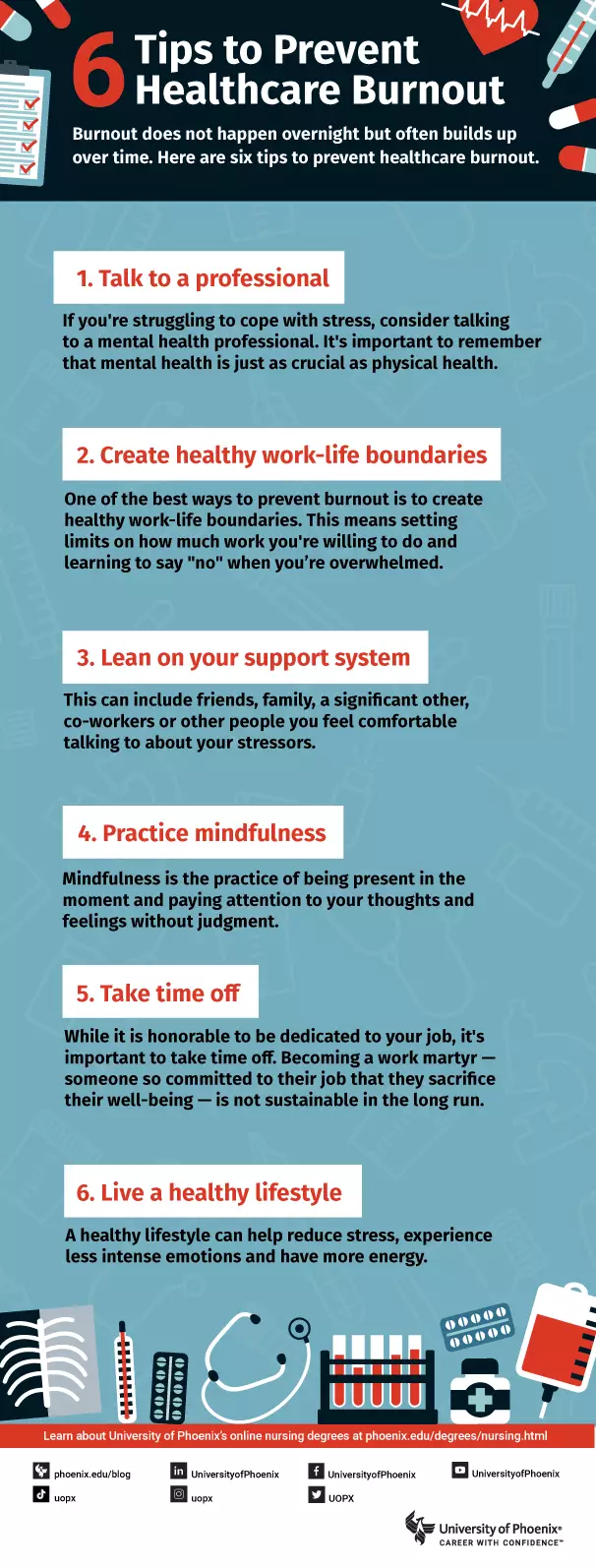
Six tips for combatting healthcare burnout
Though you may not experience all the above symptoms, it is important to be on the lookout for any changes in your mental state or behavior that could be warning signs. Fortunately, there are ways to combat healthcare burnout before it becomes severe.
1. Talk to a professional
If you鈥檙e struggling to cope with stress, it鈥檚 important to talk to a mental health professional. However, many find this isn鈥檛 the easiest thing to do.
One reason healthcare workers might not seek mental health treatment is the , especially as it relates to impacting their careers.
Despite this challenge, try to remember that mental health is just as important as physical health, and seeking professional help can occur in several ways outside of a traditional appointment. Some additional resources available are:
: Provides free therapy to front-line healthcare workers, such as individual and group counseling.
: The University of North Carolina School of Medicine designed this free mobile app to help healthcare professionals and first responders access resources to take care of their mental health.
: Provides free, licensed mental health assistance to healthcare professionals without insurance.
: Provides mental health counseling for those who have served in the military or work as rare-disease caregivers.
2. Create healthy work-life boundaries
One of the best ways to prevent healthcare burnout is to create healthy work-life boundaries. This means setting limits on how much work you鈥檙e willing to do and learning to say 鈥渘o鈥� when you鈥檙e overwhelmed.
Sometimes you may feel pressure to take on an extra shift, but you have to ask yourself, 鈥淚s taking this on going to negatively impact other parts of my life?鈥� Finding a healthy balance is crucial to your mental and physical health.
Some tips for creating healthy work-life boundaries are:
Create a 鈥渨ind-down鈥� routine: This can be as simple as reading for half an hour before bed or taking a few minutes to meditate after work.
Make time for hobbies: Dedicate time each week to doing things you enjoy outside work.
Set limits with work: Don鈥檛 be afraid to say 鈥渘o鈥� if feeling overwhelmed.
Boundaries and limits are crucial for healthcare professionals, and it鈥檚 important to remember you can鈥檛 be effective at your job if you鈥檙e not taking care of yourself first.
3. Lean on your support system
Another way to prevent and deal with burnout is to lean on your support system. This can include friends, family, a significant other, co-workers or other people you feel comfortable talking to about your stressors. They can provide much-needed emotional supportwhen you鈥檙e overwhelmed.
Tips for leaning on a support system include:
Talk about stressors: Venting can help you feel better and may provide helpful perspective.
Join a support group: There are groups for healthcare professionals struggling with burnout.
Talk with peers: If you don鈥檛 feel comfortable talking with friends or family, try talking to a peer at work. This can help you feel less alone and may give you some helpful ideas for dealing with stress.
4. Practice mindfulness
Mindfulness is the practice of and paying attention to your thoughts and feelings without judgment. Mindfulness can help you become more aware of your stressors and learn how to deal with them in a healthy way.
Tips for practicing mindfulness include:
Focus on breathing: This can help you feel more grounded and present.
Try guided meditation: Many apps and websites offer guided meditation to help you learn how to meditate.
Practice being grateful: Take a few minutes to write down things you鈥檙e thankful for each day. This can retrain your focus on the positive aspects of life and ease your stress.
It鈥檚 important to remember that mindfulness takes practice, so don鈥檛 get discouraged if it鈥檚 difficult at first. As with any skill, the more you practice mindfulness, the better you鈥檒l get at it.
5. Take time to unwind
While it鈥檚 honorable to be dedicated to your job, it鈥檚 important to use your vacation time or arrange your schedule so that you have dedicated days off work. Becoming a 鈥� someone so committed to the job that they sacrifice their well-being 鈥� is not sustainable in the long run. And as a healthcare provider you may particularly experience barriers to using your vacation time, such as:
Guilt for leaving
Understaffing
Fear of being replaced
These are valid concerns, but it鈥檚 important to remember that vacation time can be essential for improving your mental health. This doesn鈥檛 necessarily mean you need to take two weeks off to go to the Caribbean. It could just mean taking a day or two off here and there to unwind at home.
This approach could also mean switching shifts with a co-worker to better accommodate your current mental health needs. Even taking one day off when you鈥檙e feeling overwhelmed can help significantly lower stress.
6. Practice a healthy lifestyle
A , experience less intense emotions and have more energy. Small lifestyle changes can make a big difference.
A healthy lifestyle has many facets, but some of the most important ones for mental health are:
Diet: Healthy foods fuel the body.
Exercise: Exercise releases endorphins, which have mood-boosting effects.
Sleep: Getting enough sleep is essential for mental health.
Hydration: Staying hydrated helps the body function properly.
Understand when it might be time to change specialties or careers
Understanding the distinction between burnout and the need for a different concentration in nursing or even a new career is crucial. While burnout can result from many factors, such as job stress, it doesn鈥檛 necessarily mean you should quit. To understand whether you鈥檙e experiencing burnout or if it鈥檚 time to find a new role in the workforce, ask the following questions:
Do I still enjoy going to work?
Do I feel like my job is making a positive impact?
Do I feel like I have a good work-life balance?
If the answer was 鈥渘o鈥� to any of these questions, it might be time to consider a new career. There are many alternative careers for registered nurses and even more careers that involve helping people.
A few tips for switching careers:
Research career options: Many websites offer information on various careers, such as salary, job outlook and required education.
Network: Talk to people in the field you鈥檙e interested in and get their advice.
Earn additional education: If you鈥檙e interested in a career that requires a higher level of education than you currently have, consider returning to school.
Volunteer: Volunteering is a great way to gain experience in a new field.
With careful planning and research, career-driven nurses and other healthcare providers can be on the right path to finding a new role that鈥檚 a better fit.听
Healthcare burnout and education options
If you鈥檙e struggling with healthcare burnout, 果冻视频 offers online healthcare programs that might give you some fresh perspectives on your career path:
Looking for more ways to combat burnout? Watch the video .
Mindful Meditation For Nurses
0:00
Kristin is the Vice President of Student Services here at 果冻视频. She is a full-time executive, mom,
0:07
yoga enthusiast and mindset coach, exciting. She has been teaching and coaching
0:13
and has been mentoring since 1997. Kristen's role here at the university
0:18
is to ensure working adults have the services they need to juggle school and life.
0:24
So she's the person that talk to about juggling it all in this chaos, right? She inspires people to ditch mediocracy,
0:32
attain their goals and transform their lives. So we were very excited to hear from Kristin today.
0:38
Hopefully she can give us some invaluable tips on getting us through and juggling all of those hats.
0:44
So I welcome Kristen, Kristen go ahead and take it away. Thank you everybody.
0:50
- Awesome, thank you so much for having me. And for those of you who are nurses or support nurses,
0:58
thank you for the work that you do. There is something about those of us who are
1:04
in any kind of health and wellness industry where there is a under-representation
1:10
of understanding the energy that you give and that you put forth in your daily work.
1:16
So my thanks to you and my intention today is to be able to give back in some way,
1:22
shape or form one little small nugget that you can take with you to utilize for yourself
1:28
and to also share with others. I do have the chat going and this side screen for me and I see some participants,
1:35
people keep continuing to kind of hop in, so as you hop in, welcome aboard.
1:40
If you've got any questions please start to send them in the chat, any comments, anything that's resonating with you,
1:48
that helps me know where we're at and where we're coming from. So as I get started, I'm gonna ask what brought you here today
1:56
and how does stress show up for you right now? So that can be anything no right or wrong answer,
2:04
just feel free to put in the chat anything that is resonating with you right now
2:10
even if it's a, I just need a break. So we're gonna talk about Mindfulness and Meditation.
2:15
And I like to make sure you're in the right place, so you are in the right place
2:22
If you've kind of heard or practice mindfulness in some way and you're curious about it, or you're a master at it.
2:29
If you'd like to learn a little bit more and you wanna know how it can help you in your daily life, you want another tool to help lessen
2:36
to how things get to you in daily life. And you have a desire to reduce stress, lessen your anxiety and just in general, wish to be happier.
2:45
I will give you my little backdrop. I know it's been shared that I'm a yoga instructor and a mindset coach.
2:52
And I came to that through a series of events in my own life, and so there is this belief that I have
3:00
that we live in a world where wearing yourself thin
3:06
and doing what it takes at all costs, gives you the badge of honor, more than pausing
3:12
and stopping and understanding what you need to be at your best, so that you can give what more to others.
3:21
So we're gonna talk a little bit about what that means and the difference between mindfulness and meditation.
3:27
I wanna tell you that you're in good company because mindfulness and meditation particularly this year has soared.
3:33
I think some of the statistics I have on here from 2018, I'm curious how that's even changed
3:38
in the last couple of years. But since 2012, the number of people practicing meditation has tripled.
3:44
We've got about 76% of people who practice meditation for the reason of just general wellness
3:51
but we also see boosting energy levels and helping our memory and focus, being among the top reasons that people
3:58
turn to mindfulness and meditation as well. We also are seeing an increase of employers doing things
4:04
for employees to offer some mindfulness and meditation. In fact in 2018, there were 52%
4:10
of employers who saw the benefit and offered mindfulness training for their employees.
4:16
So it was also talked about that I am a mom. So this is my son. I think this is taken many years ago,
4:23
he's now going to be 18 in June and graduating high school.
4:29
I think he's mocking me here in my yoga and my meditation but we're gonna remove some of the mystery
4:35
out of mindfulness and meditation today. We're gonna talk about some of the benefits and challenges but the best part is we're gonna actually practice.
4:42
So I'm gonna ask that you be thinking about now where is that comfy place for you,
4:47
for you to be able to listen and to see, and to be able to be in a comfortable position whether that's on the floor, on a chair,
4:53
maybe you need to have some preparation for use because we're going to do some practice here at the end.
4:58
Any questions that you have along the way, put into the chat and we will answer them as we go.
5:04
So people may think that, okay I know there are the benefits of meditation,
5:12
I do things, I look at across my feed and I have some inspiration my way
5:17
and the things that I read, but reading things of inspiration, knowing that there are benefits
5:24
is not what's going to miraculously relieve any of our anxiety and our stress
5:30
nor are we be less exhausted. It's the actual practicing of it that we need to become committed to.
5:37
And so there is this notion that if I meditate,
5:42
if I am mindful, if I practice these things I'm gonna begin to eliminate
5:47
some of the stress in my life. That may be true to some degree but I offer a different alternative to that thinking.
5:56
Mindfulness and meditation is not about not having any stress or eliminating it from your life,
6:04
it is the art and the practice of knowing how to bring yourself back
6:09
to that centered place that exists when we are free from stress, right?
6:16
It exists when we're sleeping, it exists when we're on vacation, it exists when we're doing things that light us up,
6:22
that place naturally exists inside us. And so it is the art of bringing yourself
6:27
back to that place, amidst what's going on and the chaos of life, okay.
6:36
So we've got a question in the chat that says, is there a minimum or a maximum amount of time
6:41
that one should meditate at any given meditation session to get the full benefit? We're gonna practice some things that are just
6:48
for a few minutes. And I would argue that whether it's one minute or 30 minutes, it really doesn't matter,
6:56
that one minute that you do practice something is going to give you a whole host of benefits.
7:02
And the amazing thing is you can just keep coming back to it. So here you see a little Venn diagram because mindfulness
7:09
and meditation tend to be used simultaneously or in exchange for each other and there is a difference.
7:17
So meditation are, has several forms. There's love and compassion meditation,
7:22
there's consciousness meditation, there's transcended transcendental meditation.
7:28
Mindfulness is a type of meditation. And so mindfulness really is recognizing,
7:35
yes I have a full mind. I think some of you may have seen a picture that attends
7:42
to make its way across social media several times where it shows a person who's mindful,
7:48
meaning their mind is full and then there's someone who's being mindful like you see mind mindful here.
7:54
So it's recognizing that your mind is full, you're full of thoughts, you're full of worries,
7:59
you're full of anxieties, you're full of stressors. And at the same time, you pause for a moment
8:06
to be completely present in what's going on. And sometimes that being completely present is noticing I'm feeling fearful right now,
8:13
I have tons of anxiety right now, I'm noticing this stressor, my mind is going and it's allowing yourself
8:21
to pause for a moment and notice what actually is happening and going on. So you're present in that
8:27
and in doing that, it starts to dissipate and starts to wash away a bit. It's also getting into your sensations
8:33
and your taste, your smell, your touch. So I'm gonna ask you right now just to pause for a moment,
8:39
close your eyes and just notice the sounds around you.
8:49
For me, I don't hear anything but the little staticky of my computer sound.
8:55
Some of you might be hearing things far off in the background. So it's pausing and noticing what's happening
9:01
around yourself in your environment but then also getting into your body, and that's what we're gonna practice.
9:08
Benefits of meditation. There's a whole host of them,
9:14
some of them have been more scientifically proven than others. Although there is a plethora of anecdotal investigation
9:23
and accounts of how meditation has changed people's lives. The top 10 that you hear about most are
9:30
stress reduction, promoting emotional health and keeping our mind in the right place, reducing anxiety,
9:38
allowing us to have more focus and concentration which in turn lengthens our attention span,
9:44
increasing our awareness, noticing things around you which has an increased benefit
9:49
because the minute you're aware of something then you can actually do something about that,
9:55
you can choose an action. So if I'm aware in a moment that I'm being triggered
10:01
by what someone said, and that is causing me to feel like the moment I'm aware of that,
10:07
I can then choose to act a certain way about it. Versus if I'm not aware of it I just feel an act on impulse
10:15
and then I might have to like, oh wait I wish I would have not acted in that way. Improves sleep, helps blood pressure,
10:23
strengthens your immune system, improves your mood, increases your happiness.
10:29
So the one way that I would describe this is all of it is think about if you were to hike
10:37
and you were going on a pretty new trail, you could kind of see where the trail was
10:43
but there were some things in a way and you had to look really close and maybe there's some rocks or overgrown grass,
10:49
the path was it hasn't been paved that well, if you keep doing that trail over
10:56
and over and over again on a regular basis, that path becomes more clear and very easy to go to.
11:03
And think about the mind working the same way. We've got different pathways in our brain that take us
11:10
to the place of stress, that take us to the place of happiness, to take us to the place of anxiety.
11:15
And some of those pathways in our brain have been paved so clearly. And so cleanly now that they're really easy to get to.
11:24
And a lot of times it's those pathways to stress, pathways to fear, pathway to anger, pathway to anxiety
11:31
because our body's in this constant state subconsciously and we go to those places in our mind all the time.
11:37
Practicing mindfulness and meditation allows us to create new pathways.
11:42
Now I know how to go to that place of calm a little bit easier. When I first start out,
11:48
there's the overgrown grass, there's the rocks in the way, there's the I'm kind of on the pathway but did I miss it because it's new.
11:56
So the more you practice, the more you create clear pathways to be able to go to those places in your mind that help you
12:03
be in the state that you wish to be in and allow you to ultimately control your mind.
12:08
So meditation also helps us learn that the thoughts that we think and the emotions that we feel
12:15
have a physical reflection in our body. So how our mind is working so much of it is done
12:21
at an unconscious level without us really thinking about it but yet it manifests itself in our physical body.
12:29
And those are the things that we actually have as tangible evidence that something's going on.
12:35
You get a headache, you have tension in your shoulders and you need a massage. You had an overwhelmed, crying breakdown.
12:42
There's some physical manifestation that tells you, oh wait, I must be stressed about this situation
12:49
and I wasn't necessarily aware of it until it physically showed up in my body but meditation helps us learn to connect the mind
12:56
and the body together. All right, resonating, making sense?
13:04
Give me a thumbs up, give me any questions. All right, I'm gonna talk about different challenges.
13:11
So, so far it, yeah, sounds great Kristin, loved the idea makes sense
13:17
but how do you actually make this happen because it's easier said than done, just like everything?
13:24
So I'm gonna talk about four challenges that people tend to have in practicing meditation or mindfulness.
13:30
Patience, time, the busy minds and having diligence.
13:36
So let's talk about patients first. A lot of times, in fact it's happened to me
13:42
when I first started to meditate is that I have the urge to do something else.
13:47
I tell myself every morning, I'm going to sit down and I'm gonna meditate before my day starts.
13:53
But I have the urge to check Facebook, I have the urge to start working, I have the urge to want to stay in bed
14:01
but my kids are knocking at the door and they're demanding that I get up. So everything could be well-intended
14:08
but something doesn't go right because have the urge to do something else. So there's a few suggestions for how you can do this.
14:16
Yes, you need to be committed but if you have the urge to do something else, end the session early.
14:22
Craig had asked, what's the minimum or maximum number of time, amount of time that you need to be practicing mindfulness and meditation?
14:30
The correct answer is whatever works for you. So if you say I'm gonna start meditating
14:35
and I've never done it before and to say, you're gonna do that for 30 minutes a day, that's pretty self sabotaging
14:43
because 30 minutes is a long time to sit down. What if you did a minute, each day? What if you say, I want to try and do for three minutes
14:49
but if something happens and the kids start knocking at the door, I got a minute in at least one minute, end the session early.
14:56
The second one is acknowledged the feeling of impatience. So you can be sitting and practicing some breathing techniques
15:03
and you notice that you just are feeling impatient, it's hard to be still and that's uncomfortable.
15:09
Acknowledge the discomfort and notice it don't judge it, it's something to get curious about rather than
15:17
to beat yourself up about. Remind yourself of the benefits that can help and let go over and over.
15:23
So I go back to, and I do this with my yoga instruction too. It's not about letting go of everything
15:31
so you have zero distraction, it's about learning to notice the distraction is coming in.
15:38
I notice it's coming in, I'm gonna let it go. I notice it's coming in and I'm gonna let it go.
15:45
And if that's all you do, you're practicing mindfulness perfectly
15:50
because you're increasing your awareness, you're directing your attention to something specific
15:56
and you're directing it someplace else also. And it's going to keep coming back and coming back
16:01
but then later it'll go away for a little bit longer and then it'll come back and it'll go away,
16:08
it'll go away for a little bit longer. So it's a constant kind of ebb and flow
16:14
just like a constant ebb and flow of day and night.
16:20
How do you know if you're meditating correctly, if you're starting out?
16:27
It's a really great question, you're describing me so glad to hear it's normal at first, it's all about normal.
16:32
And there's no right way to meditate at all, there's no right way to meditate.
16:38
So think about what your goal is to meditate and that goal is gonna be different for everyone,
16:44
for somebody it might be, I need just 10 minutes to escape. So I'm gonna have my alone time
16:51
and if my alone time is just sitting and constantly letting my mind wander,
16:57
that is a form of meditation because you've separated yourself out of the rest.
17:03
So there, if we get into this adage, I've got to do it right, we're missing the point
17:09
because the only right way to do it is to notice and let go
17:15
and not have any judgment with it. Second challenge tends to be time.
17:20
There's always something more important that gets into the way always, this is true for anything we want to try and do, right?
17:27
I wanna have an exercise program, I wanna eat healthy like there's something. Time is always a really great excuse,
17:33
I don't have time. I always like to say, if you say you don't have time try saying it's not important
17:39
and see how that makes you feel. So if something is important to you then it becomes a priority.
17:44
So prioritizing how it may fit is very important that the perception that it's also part of your routine.
17:52
So when I talk about being your best self I talk about the fact that we work,
17:58
we live in a world where it seems we're deemed selfish if we take care of ourselves first,
18:05
and in reality I would argue it's the other way around. You're being selfish by not taking care of yourself first
18:13
because when I'm burnt out, when I am at my wit's end,
18:18
when I am overwhelmed and I am stressed then I'm not giving my family my best self,
18:26
I'm not giving my work my best self, I'm not giving my customers my best self or my patients my best self or my peers my best self.
18:34
So we often think about it in a very skewed way. Well, I need to be there for everyone else. You can't be there for everyone else
18:40
unless you their for yourself. And that doesn't mean you just, you know, well I'm not gonna take you to basketball practice,
18:48
I'm gonna take a bath instead. It's not about indulgence, it's about prioritizing what you know you need
18:56
in order to be at your best. And so the perception that having this mindfulness
19:02
time to yourself as being part of your routine is super important to take on,
19:09
getting your sleep is also important. So if you sit down and meditate, you start to get tired
19:14
and then that's a sign that you need a little bit more sleep and you're not gonna be able to have a good session if you're sleeping.
19:20
We prepare our bodies, right? People don't think that it's weird to get up and take a shower and brush their teeth
19:26
and to get themselves physically ready. We don't think that's weird at all,
19:32
In fact, we almost expect that of everyone but why is not preparing our minds
19:39
for our day, just as important. Why is not preparing how we feel on the inside,
19:45
Just as important as how we look on the outside.
19:51
Third challenge, busy mind. This is so true, Danielle. I see it, you can't pour from an empty cup.
19:58
That is so, so true, can not pour from an empty cup. Busy mind, planning, worry, wander, ruminate.
20:04
I sit down, as soon as I sit down, Kristen all I do is notice all the things that I'm worried about and that just creates more anxiety.
20:11
The more we quiet ourselves, the more we notice what comes up and that's what distracts us and causes more restlessness.
20:19
So again, it's not about the mind being empty but it's about consistently bringing yourself back.
20:27
I would also argue that we oftentimes move away from what's uncomfortable.
20:35
So a lot of people, I'll use sleep as an example, a lot of people complain that they have trouble sleeping
20:42
because when the day is done, I go to bed, and as soon as I start to quiet
20:48
that's when my mind starts to run. And so that used to happen to me quite often
20:55
I either I couldn't get to bed or I'd wake up at that like three o'clock, four o'clock hour and my mind would just be going.
21:02
And I was able to satisfy that by telling myself, I'm just sitting here worrying and ruminating on things,
21:10
now's not the time for that. I'll give myself an hour to worry and ruminate on stuff when I get up
21:15
but right now, you know, I need to sleep. And for whatever reason that knowing that I could give myself another time to worry
21:22
really helped me. And then I found when I was actually up and doing things, you don't worry about it. So having a busy mind, when you sit down
21:30
to actually meditate is something to get really curious about, it's something to notice, not to judge that I'm worrying right now.
21:38
What am I worried about? And if you need to, you can pause your meditation to actually write out,
21:44
these are the worries that are distracting me. This is a real thing that I keep coming back to and then you can figure out how do you want to tackle that?
21:52
And so it's not about trying to empty, it's about noticing and letting go.
21:58
Should you try to stay consistent once you start practicing meditation, same location, same position, same time of day,
22:04
eyes opened or closed? Awesome questions, Craig. So it really is your choice.
22:10
Consistency helps, yes because you're creating a habit and a habit needs consistency.
22:18
It doesn't matter if you choose to do it in the morning or in the night time, it doesn't matter if your eyes are open or your eyes closed.
22:25
Some of those are techniques that you can learn to live with. Now, if you follow a certain type of meditation
22:30
or a certain type of mindfulness they may teach you to do it in the morning.
22:36
For instance, I'm practicing at a meditation right now that says you should do it first thing in the morning and you should shower right before you do it,
22:43
get up shower and meditate, right. I practiced for a while and then I realized like, you know what
22:49
some days doing that right when I get up doesn't work, so I know that I wanna be consistent
22:54
and I do it every day during the workweek but it doesn't always happen in the morning. Sometimes it's in the morning, sometimes it's at night
23:01
but at least I've gotten it in. So you get to determine what your consistency is and you get to determine what your timeframe is.
23:09
Same location. Having a location helps. So having a space helps.
23:15
I have a meditation cushion, I can take that cushion with me anywhere. So it doesn't have to be the same location
23:21
but if you are doing it in your house knowing that here's your space and that space is dedicated to it,
23:27
just like you have a space for your bed, that's important because you're giving it commitment,
23:32
you're giving it some type of importance and you're kind of lifting it up
23:37
to be part of your routine a little bit differently, so having a place for it is helpful.
23:43
I have found the most success for myself by incorporating short mindfulness activities throughout my day
23:48
but would like to work out to longer meditations. I love that, Megan. So that's an excellent way to start
23:54
because you can build anything for a minute, right? Like my apple watch tells me to breathe for a minute.
24:01
And I don't, sometimes I hit dismiss, and I'm not being consistent with it but really a minute for anything that's doable,
24:09
that's doable. So if you start with a minute and then you gradually work your way up but don't make it hard.
24:15
It doesn't have to be hard and it shouldn't be a thing that says, if I didn't do it, I'm gonna then beat myself up for it.
24:22
Anything is going to be helpful and the more you do it, the more you practice, the more you're going to feel the value
24:29
and the more you're going to crave it. And then it's easier to do it for a longer period of time.
24:35
Last one, here is diligence, we've kind of talked about this all along. You do have to be committed
24:41
but a lot of times we sit and it's hard and we don't know if we're doing it right
24:47
because it's all internal, we can't see it, we can't feel it tangibly,
24:55
we can't go show another person. So we get wrapped up in these thoughts of like,
25:00
I'm not even sure if I'm getting what I'm supposed to be getting out of this. And you know, so then we just get up
25:06
and we give up too soon. I say, stay after the initial calmness.
25:12
So if any of you who are on here have tried mindfulness
25:17
or meditation, and you've had just a snippet of like, oh that feels different.
25:23
I feel different, I feel calmer, when you hit that point sometimes it's easy to then stop.
25:30
All right, I feel really calm. Okay and that was my stopping point. I say, push past that.
25:37
Once you feel that initial calmness, sit and savor it for just a second longer
25:42
and then you've allowed yourself to lengthen your time and get comfort in the discomfort.
25:49
You know, there is I wanna try and do this for 10 minutes. You could sit there and push through
25:55
and do two 10 minutes of absolute discomfort. Yes, you could do that. You could say, I'm gonna do it for 10 minutes
26:01
and three minutes into it, my leg fell asleep and I'm totally uncomfortable. That doesn't mean you have to sit
26:06
for another seven minutes doing it with your leg asleep. You maybe changed positions and say,
26:11
I'm just gonna do 30 seconds more. I'm totally uncomfortable right now but just let me give 30 seconds and see how it feels.
26:20
All right, we're gonna practice and we have 30 minutes left.
26:27
So we're not gonna practice for 30 minutes. I would love to get either your questions,
26:34
the things that you're concerned about the things you've tried offering up
26:40
any other tips to each other because you're all going to have your own experiences.
26:46
I'd love to get some of those going in the chat. Craig has a question. Are there any tips for meditation techniques
26:52
with people who have a health condition, example, asthma? You know what?
26:58
Yes there is. So we're going to do some, a breathing technique as part of our practice.
27:04
There's a variety of them. Any type of health condition can be worked around.
27:11
I would say that my largest tip is that if you do have asthma, you need to be careful
27:17
about the types of breathing that you do take on. So there are some, there's a variety
27:24
of breathing techniques but there's some that can be a little bit more intense. And so you wanna be with something
27:30
that makes you feel comfortable obviously, if all else fails, all you need to do is breathe normally.
27:37
And we're gonna breathe through our belly and practice that here in a second. If you've got other types
27:43
of limitations that may cause you to sit a certain way
27:48
or maybe you lay down and you can't lay down your back, so you lay on your side there's always a modification that you can do
27:55
so that you can be comfortable. So my biggest tip is to pay attention. What do you know about your body
28:02
and how do you then need to set yourself up to be comfortable?
28:08
You don't have to be sitting in a Lotus position with your hands crossed and some, you know
28:13
mudra or what have you. You can be sitting however is most comfortable for you, particularly when you're starting up.
28:22
Okay, so we ready to practice. Oh, we've got a couple more questions, hang on here.
28:30
Do you have any recommendations for books or resources that may help become more advanced in meditation?
28:35
Okay, I have a, there's a couple of apps that I'm going to offer you on your mobile device.
28:42
There's one called Insight Timer and there's another one called Headspace. I think huts made Headspace has become wildly popular.
28:52
And both of those offer free versions to where I think in the Headspace app,
28:58
you can actually do 10 each for three different stages.
29:04
So I think they have a three-minute a five minute and a 10 minutes, and it takes you through 10 sessions.
29:09
So you could really do a full 30 days doing that meditation Headspace app for free
29:19
and get yourself something on a daily basis for 30 days. And you can do them over and over again,
29:25
they also will send you some quotes that can pop up and give you as a reminder. Insight Timer also has a free version
29:32
and there's a variety of guided meditations. So if you find that your mind is really busy,
29:40
some techniques that I use, one is my breath and what I do with my breath and concentrating on my breath.
29:46
And another one is to do a guided meditation because if you're hearing somebody else's words then you're focused on the words
29:53
and you're less likely to have your mind wander. It still will and you still will bring it back
29:59
but it gives you something to concentrate on and that can be helpful. There are a variety of different books
30:05
that are on meditation that you can have, there's also different courses on meditation as well.
30:10
A lot of the self-help arena has areas of meditation.
30:17
I've always found that it's nice to have something that's more on audio because then you've got the practice with it.
30:24
I've read a couple of meditation books where they've got the guided meditation in the actual book and you have to read it,
30:32
and it's like, well I'm not gonna really read the meditation, I wanna do the meditation. So if you get the audio book,
30:38
then it can give you that guided that way. Excellent question.
30:45
In the racing mind, just reading here seek moments of peace feel like times. Yes, mind is always racing.
30:51
It's a really, really big problem for us. Randy says, I like to focus on body parts and visual color light coming into that area.
30:58
We're gonna talk about that, we're gonna do that. I start at the top of my head and worked myself down to the right side of my body, to my toes,
31:05
come back up and then go back down, I love it. So in the example, I see my head, right elbow
31:11
and visualize light blue shining in that area. Yes, so visualization can also be
31:17
a really great way to pave that pathway and to keep your mind focused on something,
31:23
so it's not complete space, right? And visualization works really well to be able
31:30
to also notice and get into your body. Because a lot of times we try, we get distracted
31:38
and if we pause and the minute we get in our body, your body's gonna tell you more.
31:44
It really knows a lot. And if we learn to listen to it it will tell you what is going on
31:51
before it becomes a problem so I love that, excellent. Love Headspace.
31:57
Yes, It's a great one. Okay, so let's practice.
32:02
I'm gonna ask for you to find a comfy space and that may be sitting in a chair at maybe laying down,
32:10
it might be sitting on a floor whatever that looks like for you,
32:15
let it be and find yourself in that spot.
32:20
And I'm gonna ask you to close your eyes.
32:26
And for a moment, I want you to just notice your body
32:32
in the space that it's in. Just notice that you're lying on the floor in a room,
32:42
you're sitting in a chair and feel the chair underneath you.
32:47
You're sitting on the floor wherever that is for you picture and visualize your body
32:53
taking up the space that it's in and notice the space that you're in.
33:01
And then I want you to start to notice your breath. So for those of you that really are wondering
33:09
what is one thing that's super simple I can do? This is it.
33:16
On the inhale notice your breathing in, on the exhale notice your breathing out.
33:25
Inhale your breathing in, exhale you're breathing out.
33:32
Easiest, simplest exercise any time of the day you can do.
33:38
I'm breathing in, I'm breathing out. I'm breathing in, I'm breathing out.
33:47
I'm breathing in, I'm breathing out. So if that works for you, you can hang on to it.
33:56
And as you notice on the inhale, you're breathing in. Notice how it begins to expand.
34:05
And as you exhale on the exhalation and you notice that you're exhaling and breathing out,
34:12
notice what happens as the breath releases.
34:18
As you inhale there's a natural expansion. I'm breathing in and on the exhale
34:25
there's a natural depression releasing, letting go.
34:32
I'm breathing out, I'm breathing in, I'm breathing out.
34:40
On the inhale Notice the belly as it rises, expanding.
34:50
And as you exhale, notice the belly as it releases.
34:56
So it's called diaphragmatic breathing where you breathe starting from your belly.
35:02
So maybe you put your hand there wherever it is that you are laying seated, wherever you might be.
35:11
And as you inhale, feel your belly press against your hands.
35:17
And as you exhale, notice your hands kind of release and sink toward your spine.
35:24
And then you're gonna start to deepen that. So as you inhale, you let your belly expand,
35:31
keep inhaling you notice your ribs start to expand, keep inhaling you feel that breath
35:37
all the way into your chest. And then as you exhale, I'm breathing out.
35:42
I release from my chest, I release from my ribs, I released from my belly.
35:49
As I inhale my belly expands into my ribs, into my chest.
35:56
As I exhale, I release from my chest and my ribs and my belly.
36:02
Breathing in, I breathe in, I breathe out.
36:08
And see if you can create longer fuller breaths.
36:15
I'm breathing in, I'm breathing out.
36:21
So your concentration and your awareness is only on your inhales and only on your exhales
36:30
and start to notice what happens at the very top of that inhalation
36:37
right before you exhale there's a space, there's a pause.
36:47
And what happens at the very end of that exhalation
36:52
before you take your next inhale, there's a pause, there's a space.
37:01
I'm breathing in and breathing out.
37:07
We're gonna do something that is called the 5-5-7 breath. We're gonna inhale for five,
37:15
we're gonna hold for a five and we're gonna exhale for seven.
37:22
So on your next exhalation, let out all the breath.
37:27
Then as you inhale counting one, two, three, four, five
37:37
hold one, two, three, four, five and exhale.
37:47
One, two, three, four, five, six, seven, inhale.
37:57
One, two, three, four, five,
38:04
hold one, two, three, four, five exhale.
38:13
One, two, three, four, five, six, seven inhale.
38:23
One, two, three, four, five
38:30
hold one, two, three, four, five, exhale.
38:39
One, two, three, four, five, six, seven, inhale,
38:54
hold and exhale,
39:11
inhale,
39:17
hold
39:24
and exhale,
39:31
inhale, hold and exhale.
39:47
Letting the breath come back to neutral. I'm breathing in and breathing out,
39:55
I'm breathing in, I'm breathing out. And just take a scan, notice how the breath feels different.
40:05
Nothing's good, nothing's bad, you're just noticing and you're noticing the difference.
40:17
So as you breathe in and breathe out start to bring your attention back to your body.
40:26
You feel the body against whatever is underneath you.
40:34
Notice the feeling of the weight of your body on the chair
40:39
or on the floor, wherever you are, feeling your body take up that space,
40:47
breathing in, breathing out. Notice your chest and your abdomen continue to expand.
40:58
Allow the air as you inhale to fill up your lungs completely
41:03
and begin to notice the sensations of what you're aware of.
41:10
I am breathing in, I'm breathing out. What sensations come to the forefront initially,
41:19
just notice.
41:25
I'm breathing in I'm breathing out. And as you breathe in, you breathe in space.
41:32
As you breathe out, you notice stillness. There's a sense of relaxing,
41:38
there's a sense of releasing on the excalation.
41:45
Begin to bring your attention to the top of your head, noticing the sensations in your scalp,
41:55
around your hair, the back of your head, the sides
42:03
and then bring your attention to your face, your brow, the temples, the corners of your eyes
42:17
and bring your awareness to your mouth. Noticing if your jaw is relaxed or clenched,
42:25
maybe you move it around and you let your lower jaw kind of sink and the corners of your mouth relax.
42:34
As you move to your neck, feeling the sides of your neck,
42:40
the back of your neck, into your collar bone, your collar bones spreads, your shoulders then relax.
42:51
You can feel the front part of your shoulders but also the back part of your shoulder blades.
42:59
And the very bottoms of your shoulder blades rest and settle, allowing your arms to relax
43:09
feeling the left side from your shoulder down to your elbow, to wrists and your fingertips.
43:21
Maybe your left palm is a little bit tingling,
43:26
bringing your attention to your right shoulder, down to your right elbow
43:32
into your right forearm and wrist
43:38
into your right fingertips and your right palm.
43:45
So your head and your neck and your arms are completely relaxed.
43:52
And then bringing your breath into your chest. I breathe in, I breathe out.
44:01
Can feel the right side and the left side of your chest releases,
44:07
the left side of your ribs and the right side of your ribs relax,
44:15
into your hips, the hip creases, the buttocks.
44:25
So from your head through your neck, the collarbone and all down your arms, into your torso.
44:33
The body's filled with space. Now breathe in, now breathe out.
44:41
Bringing your awareness into your left leg, the left thigh, the knee cap, the left back of the knee,
44:50
the left shin, the left calf, into the left ankle
44:57
all the way into the left foot, pinky toe, all the toes, top of the foot.
45:10
Bringing the breath into the right leg, the right thigh,
45:15
back of the thigh, the knee cap, the back of the knee,
45:20
into the shin, the calf, right ankle, right heel,
45:30
all the way into the right toes, pinky toe, all the way to the big toe in the top of the foot.
45:40
So your whole body from your head, your arms, your torso, the right leg, the left leg completely still.
45:51
I breathe in and breathe out. And as you breathe in and you breathe out
45:58
begin to visualize your spine. Your spine completely at ease, holding your entire body
46:09
whether you're sitting or you're laying down. And you can picture that spine as a hollow tube,
46:19
filled with space and breath. I breathe in, I breathe out,
46:28
as you breathe in, you're breathing in relaxation,
46:34
peace, space, calmness, stillness.
46:42
And as you breathe out, that fills that hollow too in your spine,
46:49
each inhale, breathing in more space, each exhale
46:55
allowing that energy in the tube to circulate more and more.
47:01
And maybe that tube begins to have a light to it,
47:06
maybe it's a widest shield, maybe it's a brighter blue light,
47:13
completely centered, completely calm.
47:18
We breathe in and breathe out.
47:23
And as you keep this, you can start to visualize that light in your spine,
47:29
start to spread to all parts of your body.
47:35
Taking it first to that left arm, down into the left hand.
47:45
And then that lights opens to the right side, into the right shoulder, into the right elbow,
47:53
down to the right fingertips. And that light starts to swirl around your rib cage,
48:03
into your hips, as it spreads into your left leg, your left hip,
48:09
your left knee, into your left ankle and to your left toes.
48:17
And then it swirls into the right hip, down the right leg and to the right knee,
48:24
into the right calf and ankle and to the right toes. So your whole body, I breathe in, I breathe out.
48:34
Filled with light, filled with calm, filled with what is naturally your center and you.
48:45
And as you keep that begin to feel the energy in your body,
48:54
begin to visualize your body laying on the floor
49:00
or sitting in the chair. Begin to notice your body (mumbles)
49:12
and noticing your body being able to be a part
49:18
of the room that you're in.
49:25
I breathe in, I breathe out.
49:30
Begin to notice the sounds in the room,
49:36
begin to notice any smells of the room,
49:43
begin to notice the floor underneath you and your body grounded in this space
49:52
that it is laying or sitting in.
49:58
And very, very slowly I breathe in, I breathe out.
50:07
Keep your awareness, keep your breath but start to open your eyes.
50:14
And as you open your eyes, you breathe in, you breathe out and you just notice
50:22
and you saver just for a moment, how you're feeling, how it's different,
50:31
notice what you see in the room and begin to bring yourself back.
50:40
(bell chimes)
50:58
It's always really difficult when I can't actually see people to know where you're at
51:07
and how you are doing and taking up the space. So I'm gonna linger in mind words just
51:14
to let everyone come back. And if there are any comments or any questions,
51:22
certainly feel free to begin to put them into the chat. And in the meantime, I will share
51:29
that we went a little bit longer than I anticipated, mainly because I was feeling it,
51:34
so hopefully you are feeling it too. And my intention today is that you could take one thing from today's practice
51:43
and session to be able to use for yourself, to potentially share with others
51:50
and to give back to yourself for the work that you do. So I hope that you were able to take something from that.
51:56
And I'm always here for you with any questions that you might have for me.
52:02
Thank you very much for letting me lead this.
52:08
- That was amazing. Thank you so much, Kristin. I feel so relaxed, I don't know about you guys (laughs).
52:15
That definitely- - Absolutely. - I'd love to add to my repertoire every day. Yeah, so much of that really was brought home to me.
52:23
Like before you go to bed, your mind racing with all the things you need to get done. I mean, this is just fantastic
52:29
and I'm sure the nurses all appreciate this. Thank you so much, everyone for joining us.
52:35
We have two more webinars this week for our Nurses Week that we'll continue on.
52:40
Next Tuesday do join us for Male Nurses Bridging the Gap where we'll from some great alumni
52:47
and nurses that have reached a very high places in their careers with nursing.
52:53
And then of course we have another mindful meditation series at 7:00 PM on Wednesday with Christopher Dennis
52:59
so do join us for that one as well. It seems like we got some great meditation enthusiasts today
53:04
and Kristen, this was wonderful. And again, this recording will be available to all the nurses who weren't able to attend today.
53:11
We thank you all. And one last thing, we did leave a couple of links in the chat for everybody,
53:17
do feel free to copy or click in them, if you'd like more information about the nursing degrees
53:23
and also the link to register for the next two webinars this week this coming week. Happy Nurses Week everybody
A graduate of Johns Hopkins University and its Writing Seminars program and winner of the Stephen A. Dixon Literary Prize, Michael Feder brings an eye for detail and a passion for research to every article he writes. His academic and professional background includes experience in marketing, content development, script writing and SEO. Today, he works as a multimedia specialist at 果冻视频 where he covers a variety of topics ranging from healthcare to IT.
ABOUT THE REVIEWER
Dr. Raelene Brooks, dean of the College of Nursing, has been a registered nurse for more than 25 years and practiced extensively in the areas of ICU, trauma and critical care.听Her publications include a focus on nursing education, critical care, and organizational wellness and engagement. She is a leader in creating, guiding and launching innovative curriculum.